Click on images below to enlarge:
|
 |
|
|
|
|
|
I inadvertently captured the main entrance to the building in the
background of a
shot taken on a different outing.
| A curved stream along the northern side of the museum. It reminds me
the stone river at Stanford's Art Museum: pictures
one, pictures
two. I like how it mirrors the building's curves.
| A series of waterfalls.
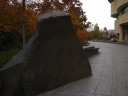
| The nearby stone that, if one stands a few feet in front of it, one can
hear the roar of the water concentrated on that one stop. Neat. It's
like one of those whispering chambers/spots, just with water and stone.
|
|
|
|
|
|
|
|
| Some of the clay sculptures modeled off tipis or huts in the series
Always Becoming by Nora Naranjo-Morse. I like the idea that clay
will change as it interacts with nature, just as the native Americans
changed through their interaction with the land.
| Neat. Good to know for vegetarians.
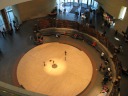
| Kids playing in the central atrium. Also, I like the sculpted metal
that surrounds the area.
| Looking up, a series of concentric rings ... and rainbows.
|
|
|
|
|
|
There's a lot going on in this bronze.
Artificially brightened.
| Details. Sorry I didn't capture the pine tree in the previous picture;
I wanted to focus on the detail of the people, their belongings and
companions.
| An aesthetically appealing array of tribal sculptures.
| No honor.
|
|
|
|
|
|
| A copy of a 1500s cave painting of a horse. It's hard for me to imagine
now that I know better, but initially Native Americans thought the
combination of horse and rider was one creature.
| This wood carving, For Life in All Directions by Roxanne
Swentzell, displayed prominently by the entrance to the museum's main
theater, doesn't seem family friendly.
| Many of the tropical fruits I associate with southeast Asia originated
in the Americas.
| Di Yin would like some of the things for sale in the museum store such
as these cute bird carvings.
|