Click on images below to enlarge:
|
 |
|
|
|
|
| The large glass blobs that are the NSA's headquarters, surrounded by a
huge parking lot.
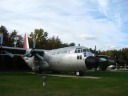
| National Vigilance Park has a few reconnaissance planes on display. Two
are shown in this picture. The large plane is a C-130.
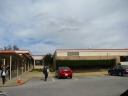
| The National Cryptologic Museum is a non-descript single-story building
(former a motel), quite a bit removed from the NSA buildings.
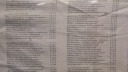
| An insanely detailed code sheet. Can you imagine what it was like to
have to sit down and decide on all these messages? And then prioritize
them by deciding to make some easier to send than others. Q-I-Q-I is
scary. I hope I never have to send J-V-J-V or, for than matter, anything
in the vein of Q-Q-Q-Q.
|
|
|
|
|
|
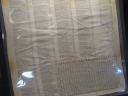
| A picture of the code sheet as a whole. It's probably pretty
comprehensive.
| Sometimes you can get an advantage not by how smart you are at doing
something but by being able to do it quickly.
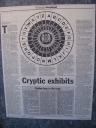
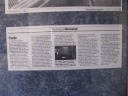
| An article about the museum, published in the Washington Times a bit
after its opening.
| Page two of the article. This page is more interesting, describing some
particular exhibits.
|
|
|
|
|
|
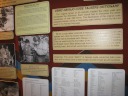
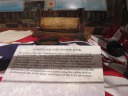
A detailed sign explaining the Navajo language code the U.S. used during
WWII. The full-size image is legible. The big text provides a good
overview. The small text at the bottom shows the dictionary used by the
Navajo. While most needed words already existed in Navajo, it's
interesting that some invented words use the English spelling as
inspiration. For instance, the Navajo word they chose to mean "abreast"
literally translates as "ant breast." Also, activity become the
Navajo that means "action ending in Y." On the other hand, the names of
organization don't bear a connection to the meaning: division becomes
salt, regiment becomes edge water, company becomes Mexican, etc.
Also, I'm amused that Africa is in the list of Names of Countries (and
its literal translation in Navajo means blackies).
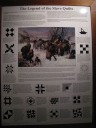
| A huge poster explaining the codes in slave quilts that were used to
direct escaped slaves to freedom. The full-size image is readable. As
the text explains, it's likely that slave quilts played little to no
role for escaping slaves--the codes are probably more legend and useful
in reality--but they're nevertheless interesting to see what messages
were thought to be physically or emotionally important to convey.
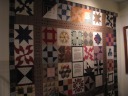
| For completeness, a picture of the sample slave quilt accompanying the
previous chart.
| A Civil-War-era cipher device. Also an example that, through user
error, even a secure system can be made insecure.
|