Click on images below to enlarge:
|
 |
|
|
|
|
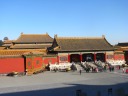
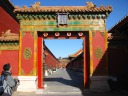
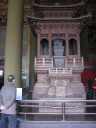
| I think this is the Gate of Heavenly Purity, but I'm not sure.
| A panoramic movie of the Imperial Garden (Yuhuayuan). The narration is
the coworker I was exploring with.
| Another panoramic movie of a different part of the Imperial Garden. If
you have your speakers on, you can hear music in the background.
| A snapshot of one building in the garden: the Hall of Imperial Peace.
|
|
|
|
|
|
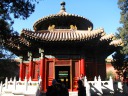
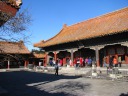
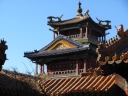
The Thousand Year Pavilion, clearly freshly painted.
I observed the
most impressive, largest buildings that one sees first upon entering the
Forbidden Palace were kept clean. Most other palatial buildings were left
to tarnish. If the pattern continued, I guess this is one of the more
important buildings in the gardens, and one people are likely to see
first.
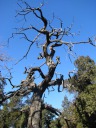
| A gnarly tree.
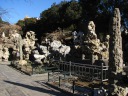
| The rock garden.
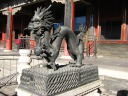
| A dragon. My coworker told me that dragons in China have four claws
except for the Imperial Dragon which is reserved for the emperor and is
supposed to have five.
|
|
|
|
|
|
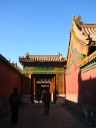
| One of the lanes in the part of the Inner Palace where servants live,
taken simply to show the contrast with the rest of the City.
| Buildings where concubines (or some other type of servant) lived.
| A colorful set of rooftops crowded with animals.
| Another sample picture of a lane in the servants' quarters.
|
|
|
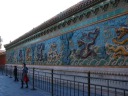
| The Nine Dragon Screen Wall.
|
|
| Forbidden City's Treasure Gallery
|
|
|
|
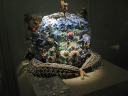
| An elaborate head ornament for women.
| Look at all the carved dragons on lintels! Also look at the
wallpaper--it's not a repeating pattern; the dragon symbol appears in many
different poses and orientations.
| A sample of the imperial seals. If you view the full-sized image, you can
see the pattern in the reflection on the mirror underneath the seals.
|
|
| More Forbidden City
|
|
|
|
|
| The path leading into the Quinlong Garden.
| In the Pavilion for Bestowing Wine, a winding path of liquid is carved
into the stone floor.
| Hanging artwork in the Pavilion for Bestowing Wine.
| Inside an exhibit of jade sculptures, Spring Dawn on Cinnabar
Terrace. Finely carved.
|
|
|
|
| The Da Yu Curbing the Flood illustrated a legend. It took six
years to carve.
| One of the most compact courtyards I saw in the City. Also, one of the
few with trees.
|
|
| Forbidden City's Clock Museum
|
|
|
|
|
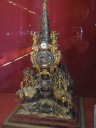
| A representative Chinese clock from this museum: ornate and elaborate.
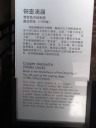
| I took a picture of this massive water clock because I liked how it works.
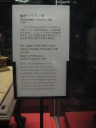
Read the text in the following picture.
However, after reading the
description of how the clock works, I cannot identify where the pieces the
description refer to actually appear on the clock / in this picture.
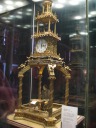
| A cool design for a clock.
| Another cool clock, again photographed because of what it can do.
|
|
|
| I'm amazed a clockmaker can make a dependable mechanism that's complex
enough to make a human figure write.
|
|
| Jingshan Park
|
|
|
|
|
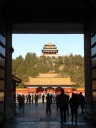
| Looking through the northernmost gate in the Forbidden City toward
Jingshan Park. The building at the top of the hill is the Wanchun
Pavilion. The building in the foreground is the Qiwang Pavilion.
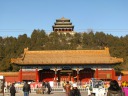
| A closer view of the park and the two pavilions.
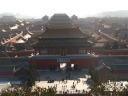
| The Forbidden City as seen from atop the hill at Wanchun Pavilion in
Jingshan Park. Look at all the roofs!
| A panoramic movie of the same scene, starting looking east then swinging
south toward the Forbidden Palace, and closing looking west. You can see
a lot of Beijing in this video, not just the Forbidden Palace.
|