Click on images below to enlarge:
|
 |
| Bus to Melaka
|
|
| Malaysia--at least this part--is green and flat. This nature doesn't
feel foreign.
|
|
| Melaka
|
|
|
|
|
| Stadthuys, formerly a Dutch-built town hall (1650), now houses several
museums that I visited the following day. This
circle/intersection/square is the center of town.
| The fountain in front of Stadthuys.
| Flowers by the base of the clock tower in front of Stadthuys. (The
clock tower can be seen in the photograph two
pictures ago.)
| The right side of Stadthuys, which is its main entrance, and a big tree.
|
|
|
|
|
|
| Also in front of Stadthuys were festive bicycle rickshaws, waiting for
tourists.
| A close-up of two rickshaws. Like the previous picture, I took this at
a high resolution so you can study the decorations if you want.
| The colorfully-covered stalls in the alley to the left of Stadthuys.
| Farther to the left is Christ Church.
|
|
|
|
|
|
| Another picture of Christ Church, taken later in the day in the bright
late-afternoon sun.
| Inside Christ Church.
| Christ Church has pretty, new-looking glazed tile motifs such as this
one.
| A nearby windmill, another remnant of Melaka's dutch past.
|
|
| Lunch at Hoe Kee
|
|
|
|
|
The line outside Hoe Kee, one of the most highly regarded joints for
chicken rice balls in Malaysia. This is a slight variation on Hainanese
chicken rice. Chicken rice is a deceptively simple dish that one can
find all over the place in south-east Asia. It can vary widely in
quality.
Later, I'd try one of Singapore's most famous
Hainanese chicken-rice stalls.
| My chicken rice, consisting of light, fragrant, very-chickeny rice balls,
like high-quality risotto, and moist chicken that was also tasty tasty, I
skipped the good quality chili-garlic sauce because I think it
overwhelmed the flavors. (Yes, the balls hold their shape without being
fried.)
| The chili-garlic sauce dipping sauce, I think.
|
I think the meal also came with a chili with black soy sauce dipping
sauce. The waitress showed me how to do it. I didn't feel stupid
because she also explained it to the Chinese family at the next table,
who also didn't know what they were doing. In the end, I don't think I
ended up using it.
|
|
|
| Because I sat near the front, I could surreptitiously record a movie of
the guy chopping the chicken for the chicken rice.
|
|
| Melaka's Historic Chinese Neighborhood and vicinity
|
|
|
|
|
| The Melaka River runs across the street from Stadthuys. This picture
looks down the river, away from the port.
| The giant waterwheel, as seen looking in the other direction.
| Shophouses along Jalan Hang Jebat (a.k.a., Jonker Walk) in Melaka's
more-Chinese section.
| The Baba Nonya Heritage Museum, in a restored house.
|
|
|
|
|
|
| Though the museum building (at left) is restored, other buildings on the
street (Jalan Tun Tan Cheng Lock) are not.
| A townhouse with a different design. Notice the colorful yet subtle
relief above the roof.
| A nearby house is more restored and has more flourishes.
| The Chee Mansion.
|
|
|
|
|
|
The Eng Choon Association. Look at the intricate carved dragons (on the
pillars and in relief on the building's walls) and the crisp painted
door.
I note, amused, that this is picture number 888,
appropriate for something Chinese.
| The Baba House, another historic house.
| Another look down Jalan Hang Jebat / Jonker Walk.
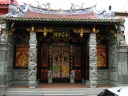
| I'm not sure what temple this is.
|
|
|
|
|
|
| Inside.
| Wah Aik shop, which sells tiny shoes for bound feet, I think is mainly a
tourist attraction, judging by the conversation I had with the shopkeep.
| The large Xianglin Temple.
| Inside.
|