Up to Boston and New England - November 17th-December 1st 2007
Top

|
November 20th 2007: More Assorted Cambridge Happenings
Page 1 of 1.
Click on images below to enlarge:
|
 |
| Lunch: S&S Restaurant
|
|
|
|
While walking to my intended lunch destination, I decided to try an
alternate route and found myself in Inman Square.
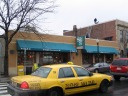
There I discovered S & S Restaurant, a Jewish
deli, though its menu ranges a bit widely beyond that.
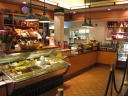
| Part of the deli counter. There are diner-like dining rooms too.
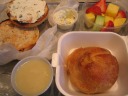
| Lunch of a toasted bagel with chive cream cheese, fresh fruit, and a
potato knish served with chicken gravy. All were perfectly pleasing; I
have no complaints, and that's saying a lot. The knish dough was
lighter than I expected, but that's not bad, just different. Also, I'd
never seen chicken gravy with knishes before. Nonetheless, it seemed to
work.
|
|
| En Route
|
|
Vivid fall colors along Washington St/Kirland St.
Also notice the colonial house on the right.
|
|
| Computer Lab
|
|
| While accessing the internet in a computer lab, I couldn't help but
overhear some students having fun shooting the breeze. (They clearly
didn't do any work while I was there, despite open textbooks, printed
journal articles, and the like.) One person claimed that the world is
dividing between people who like sauerkraut and those who don't. Another
conversation explored semantic and oral associations between maven,
macher, and a brand of a men's shaver (mach). Later, they debated the
water quality in various cities in California.
|
|
| Lecture
|
|
|
Later in the afternoon, I attended a talk, "Informal Conversations on the
Historian's Craft" by Robert Darnton. (Darnton writes popular history
books.) In this talk, he discussed his life and how it's affected what
he's done and his perspective on how one should do history.
One of his major points, accompanied by an anecdote from his days at
Oxford, was that one should tell the history, not explain the theory
about why events turned out the way they did. His tutor at Oxford,
after listening to him read an essay, in which the first half of the
essay discussed the idea of causality, about why the French revolution
occurred in 1789, asked, "Why don't you take down the scaffolding and
leave the building standing?"
Darnton's other major point involved being conscious of one's sources.
He began his talk with a story about being a beat police reporter and
learning to judge what is news. Apparently major crimes, when done to
"(b)" victims (blacks), are not news and not worth reporting, but crimes
done to "(w)" victims (whites) are news. Newspapers are selective. He
said, "what's been printed or digitized is someone else's judgment--why
limit yourself to only those documents?" (Plus, when examining physical
documents, one finds things that aren't digitized, like notes on the
back of a letter.) He wants people to go to primary sources. History
is a "detective story." He cited Tocqueville as an example of what
happens when one isn't conscious about where one gets information,
claiming Tocqueville's thesis is a product of the ("C-series") documents
he consulted. Had he consulted other documents, Darnton says he may
have come to a different conclusion. Similarly, Darnton always admired
a particular French revolutionary, but when he read some private letters
he found out the revolutionary wrote some pamphlets to manipulate
financial markets and thereby profit.
|
|
| Dinner: Dudley House
|
|
| We had some good shrimp scampi, good lamb stew (in an almost Japanese style
curry roux), and okay beef with barley.
Sorry, I forgot photograph the meal.
|
|