Click on images below to enlarge:
|
 |
|
|
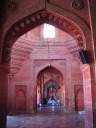
One covered side of the mosque was devoted to prayer. In this picture,
you can see people sitting on the floor, praying, in the distance.
Although we walked by them, I didn't feel comfortable taking a picture
any closer.
It's neat to see one little piece of technology: the speaker, which
could presumably be used to carry the sound of the person leading the
prayers.
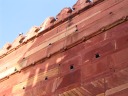
| We were told by our guide that the mosque has a fancy water drainage
system, including some drainage paths through wall adornments. I
imagine these holes are part of the less pretty part of the system. I
don't have a good picture of the well integrated part of the system.
|
|
| Fatehpur Sikri
|
|
|
|
|
| A panorama of one of the many courts in Fatehpur Sikri, an abandoned
palace complex.
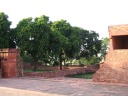
| Some terraced green areas are visible through a removed or collapsed
wall.
| Elsewhere. Notice all the columns and lack of walls.
| |
|
|
|
|
|
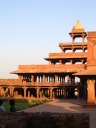
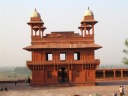
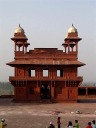
| Akbar, the emperor who built the palace, really likes colonnades. This
picture of "The Badgir (Panch Mahal)" is excellent for its
coloring, symmetry, and detail. If you view the full-sized image, you
can see how, at each level, the columns and railings are in a different
style.
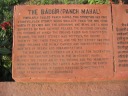
| A plaque giving interesting details on the structure photographed in the
previous picture.
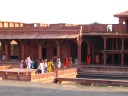
| I took this photo not because of the architecture but because this is
one of the few times on the trip that we saw a group of women. This
picture provides an opportunity to see how they're dressed.
| Diwan-i-Khas, said to be the debating chamber.
Sorry about the picture; my head is crooked.
|
|
|
|
|
|
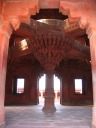
| Inside the Diwan-i-Khas. Debates are said to have happened on the
second floor where the bridges come together. Look at the intricate
column supporting the central platform.
| A panorama from the courtyard in front of the Diwan-i-Khas. Sorry it
moves so fast. If you pause it regularly (especially during
the first two-thirds), it gives an impression of the complex as a whole:
building styles, grass, trees, distant landscape, pool, etc.
Play it with sound to hear two Indian guys having a conversation; it
adds atmosphere.
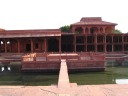
| Opposite the Diwan-i-Khas, across the large courtyard, is Anoop
Talao, a four-quartered pool, echoing, in some sense, the same style of
design.
Farther away, yet more columns are visible.
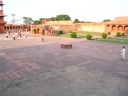
| The main courtyard has a life-sized, though very basic, parcheesi board.
(The bench is at the center of the board.)
|
|
|
|
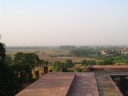
| A view of some of the land surrounding Fatehpur Sikri.
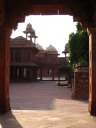
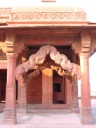
| Two archways with intricately detailed designs.
You have to view the full-sized image to really appreciate them.
|
|
| Bus back from Fatehpur Sikri
|
|
| An excellent video of a typical part of a long-distance bus ride.
The driver uses whichever lane he feels like. It's really traumatic.
You must watch it full-screen with sound for the true, whole effect.
|
|
| Dinner at The Mughal Room
|
|
|
|
|
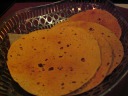
| We were given chapati when we sat down to eat in The
Mughal Room.
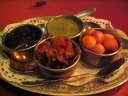
| Chutneys and other accompaniments for the chapati. Clockwise from left:
sweet mango chutney, mint chutney, sweet onions, and a lime/lemon
pickled thing.
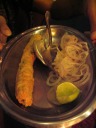
| Reshmi seekh kebab (chicken): dry, without much flavor. The lime didn't
help much.
| Kareli rogan josh: good. Had some chunks of fat.
|
|
|
|
|
|
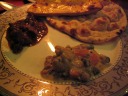
| My plate with good navratan korma (peas carrots, cauliflower, green
beans), roti, and missi roti (buttered roti, a la buttered toast). In
the upper-left is more rogan josh.
|
With dinner I drank a Royal Challenge beer. It was pretty good.
|
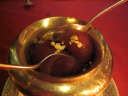
For dessert, we had zafrani golub jamin. There were like regular
golub jamin (deep-fried balls, a la doughnut holes with honey) except
that these had dried fruits inside. They were nicely fluffy and not too
sweet.
| I enjoyed the musicians who played in our dining room. This movie was
recorded for its audio only; don't bother trying to make out the very
low resolution video.
|
|
|
|
Ditto.
If you actually want to try to spot something in the
video, look at the star-shaped chandelier about ten seconds into it.
| Another movie recorded for the music only.
|